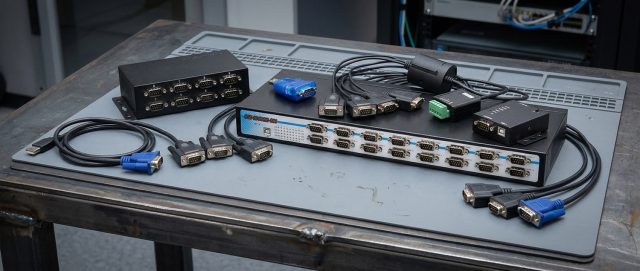
























In the world of serial communication, three standards have stood the test of time: RS-232, RS-422, and RS-485. Each of these standards has unique characteristics, advantages, and specific applications, making them suitable for various tasks in industrial, commercial, and consumer electronics. In this article, we will explore the differences between these three standards, their respective features, and their common uses.
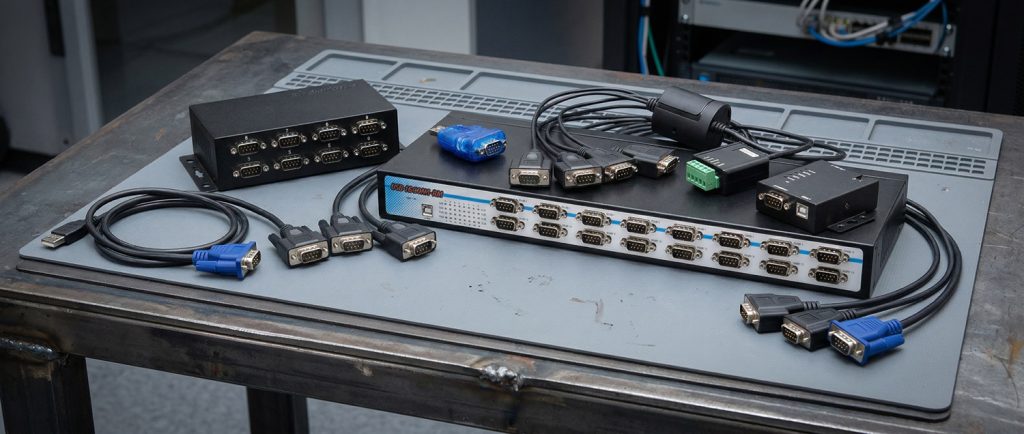
What are the Three Main Serial Standards?
RS-232
RS-232 (Recommended Standard 232) is a widely used serial communication protocol that dates back to the 1960s. It primarily facilitates point-to-point communication between two devices, typically using a 25-pin or 9-pin D-subminiature connector. RS-232 is commonly found in computer systems, modems, and point-of-sale (POS) devices.
RS-422
RS-422 (Recommended Standard 422) is a differential serial communication standard that allows for higher data rates and longer transmission distances compared to RS-232. It supports point-to-point configurations, where one transmitter can communicate with multiple receivers. RS-422 is frequently used in industrial control systems and instrumentation.
RS-485
RS-485 (Recommended Standard 485) extends the capabilities of RS-422 by enabling multi-drop configurations. This means that multiple devices can communicate on the same bus, making it ideal for networked systems. RS-485 is widely used in industrial applications, automation, and remote data acquisition.
Key Differences Between RS-232, RS-422, and RS-485
— Signal Type
- RS-232: Utilizes single-ended signaling, which means that the data signal is referenced to a common ground. This makes RS-232 more susceptible to noise, especially over longer distances.
- RS-422 and RS-485: Both use differential signaling, which transmits data using two complementary signals. This configuration enhances noise immunity, allowing for longer transmission distances and higher reliability in electrically noisy environments.
— Number of Devices
- RS-232: Supports a single point-to-point connection, meaning only one transmitter and one receiver can communicate at a time.
- RS-422: Allows one transmitter to communicate with up to 10 receivers, making it more versatile in certain applications.
- RS-485: Supports multi-drop configurations, enabling up to 32 devices to be connected and communicate on the same bus. This is particularly beneficial for networked systems where multiple devices need to exchange data.
— Distance and Speed
- RS-232: Typically limited to distances of up to 50 feet (15 meters) and can operate at baud rates of up to 115.2 Kbps. The effective distance decreases with higher speeds due to signal degradation.
- RS-422 and RS-485: Both can transmit data over distances of up to 4,000 feet (1,200 meters) and support baud rates of up to 10 Mbps, making them ideal for long-distance communication.
— Voltage Levels
- RS-232: Uses voltage levels ranging from -3 to -15 volts for a logical “1” and +3 to +15 volts for a logical “0.”
- RS-422 and RS-485: Typically operate within voltage levels of -6V to -12V (logical “1”) and +6V to +12V (logical “0”). This differential signaling helps reduce the impact of noise on data transmission.
— Common Uses
- RS-232: Frequently used in serial communication for computers, modems, printers, and POS systems. Its simplicity and cost-effectiveness make it a go-to option for short-distance connections.
- RS-422: Commonly found in industrial control systems, instrumentation, and scenarios where multiple devices need to receive data from a single source.
- RS-485: Widely utilized in industrial applications, building automation, remote data acquisition, and other scenarios that require multi-point communication.

Advantages & Limitations
- RS-232 Advantages:
-
- Simple and easy to implement.
- Cost-effective components.
- Compatible with many legacy systems.
- RS-232 Limitations:
- Limited distance and speed.
- Single connection only.
- RS-422 Advantages:
-
- Greater distance & speed vs. RS-232.
- Noise immunity with differential signaling.
- RS-422 Limitations:
- Limited to point-to-point connections.
- More complex implementation.
- RS-485 Advantages:
-
- Supports multi-drop configurations, allowing multiple devices on a single bus.
- Long distances and high speeds, making it suitable for industrial environments.
- RS-485 Limitations:
- More complex wiring and termination requirements.
- Requires careful design to avoid signal reflections.
Conclusion
RS-232, RS-422, and RS-485 are essential standards in the realm of serial communication, each offering unique features and capabilities. While RS-232 is suitable for simple, short-distance applications, RS-422 and RS-485 provide enhanced performance for industrial and multi-device environments.
Understanding the differences between these standards allows businesses and engineers to select the appropriate protocol for their specific needs. Whether connecting a simple modem or setting up a complex industrial control system, these serial communication standards continue to play a vital role in today’s technology landscape.