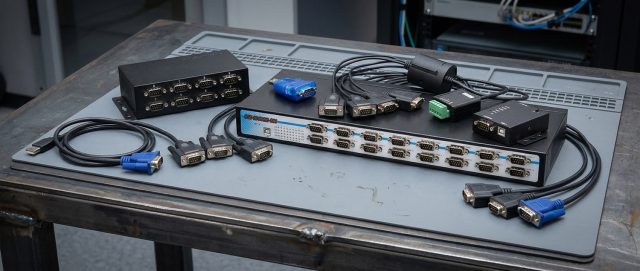
























In the world of industrial automation, factory floors, and heavy-duty IT infrastructure, not all USB hubs are created equal. While commercial-grade hubs may suffice for connecting a consumer mouse and keyboard, they quickly become bottlenecks in mission-critical environments. To understand why Coolgear’s industrial-grade USB hubs excel where others fail, we have to look under the hood at a crucial piece of technology: the Transaction Translator (TT). Multi TT USB hubs serve as a step above the rest.
What is a Transaction Translator (TT)?
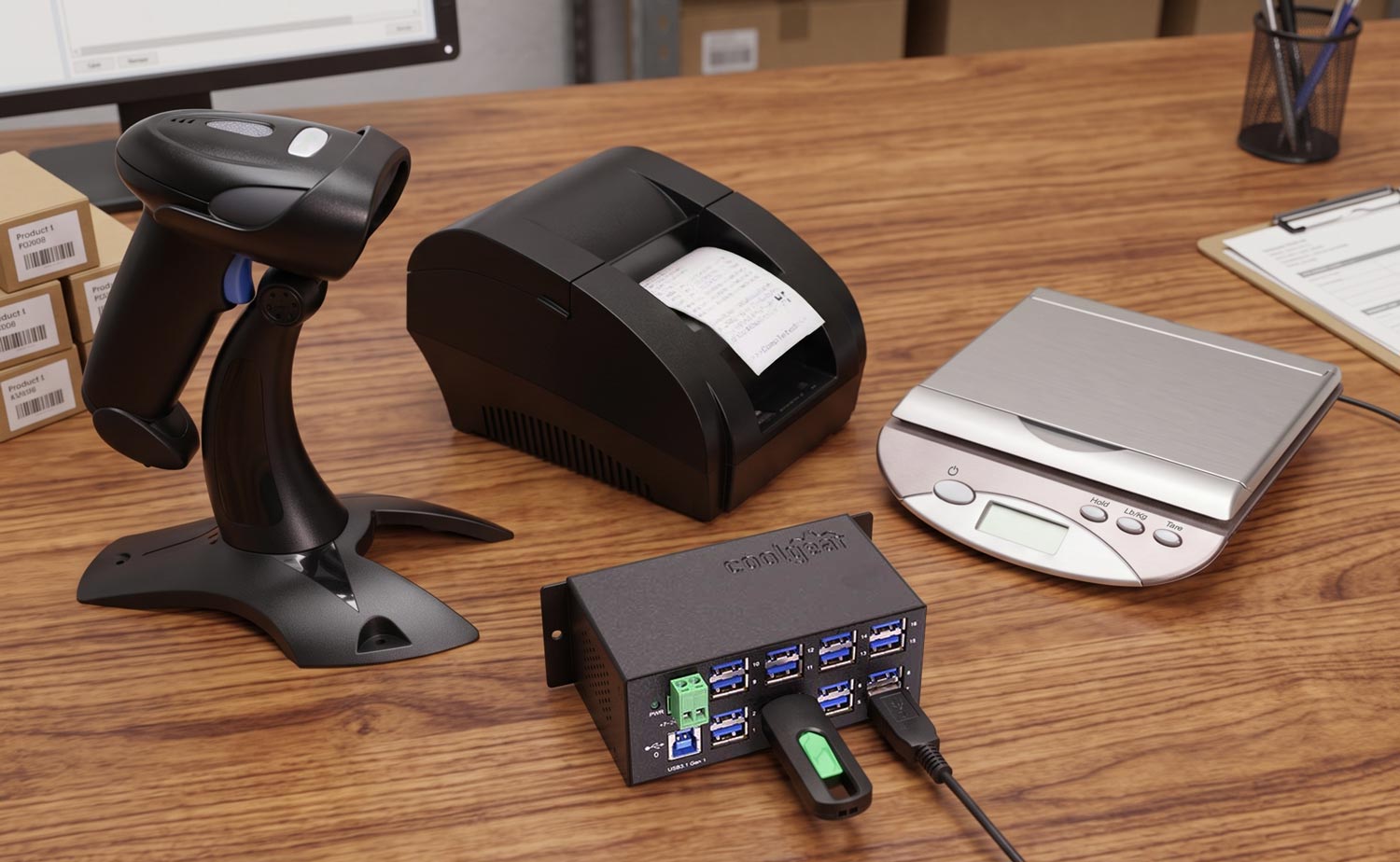
USB technology has evolved through multiple generations, from Low-Speed (1.5 Mbps) and Full-Speed (12 Mbps) in USB 1.1, up to High-Speed (480 Mbps) in USB 2.0, and beyond. However, legacy equipment, such as USB-to-serial adapters, barcode scanners, environmental sensors, and data acquisition (DAQ) modules, still predominantly operate at Full-Speed.
When you plug a Full-Speed device into a High-Speed USB 2.0 hub, the hub must translate the 480 Mbps high-speed signals from the host computer into the 12 Mbps signals the legacy device can understand. The component inside the hub responsible for this translation is called the Transaction Translator (TT).
The Bottleneck: Single-TT (STT)
Most consumer-grade and budget-friendly USB hubs utilize a Single Transaction Translator (STT) architecture. In an STT hub, there is only one translator shared among all downstream ports.
If you connect a single Full-Speed scanner, the STT handles it perfectly. However, if you populate a 4-port or 7-port STT hub with multiple Full-Speed devices (like an array of sensors), all of those devices must share a single 12 Mbps translation pipeline. This creates a severe data bottleneck, resulting in dropped packets, latency, device disconnects, and compromised system stability.
The Solution: Multi-TT (MTT) Architecture
Coolgear designs its industrial USB hubs with Multi Transaction Translator (MTT) architecture. In an MTT hub, every single downstream port has its own dedicated Transaction Translator.
“Think of STT as a single-lane bridge where all cars (data) must merge and take turns crossing. MTT is a multi-lane highway where every car gets its own dedicated lane, moving at maximum speed without interference.”
When deploying an MTT hub in an industrial setting, each connected Full-Speed device is guaranteed its full 12 Mbps bandwidth independently. If you connect seven USB-to-serial adapters to a 7-port MTT hub, the hub simultaneously processes 7 x 12 Mbps streams back to the host via the High-Speed 480 Mbps uplink.
For engineers seeking a deeper dive into the silicon-level mechanics behind this 480 Mbps to 12 Mbps translation, Infineon provides a comprehensive technical breakdown of Single vs. Multiple Transaction Translators.
Why Multi TT Matters for Your Operations
Striking the perfect balance between high-level operational efficiency and rigorous engineering specs is vital when selecting industrial equipment. Here is how MTT benefits both purchasers and engineers:
For the Engineering Team
- Data Integrity & Zero Packet Loss: Continuous, uninterrupted data streaming for DAQ systems and PLCs. No more erratic polling rates or missing sensor telemetry.
- Scalable Topologies: By eliminating the translation bottleneck, engineers can cascade (daisy- chain) multiple hubs in complex topologies without starving downstream devices of bandwidth.
- Legacy Compatibility: Seamlessly integrate newer High-Speed hardware alongside legacy Full-Speed serial equipment on the same hub without performance degradation.
For Purchasing and Operations
- Industrial-Grade Reliability: MTT hubs prevent the mysterious “device disconnected” errors that plague STT hubs, drastically reducing IT support tickets and maintenance downtime.
- Future-Proof Investment: Coolgear’s MTT hubs are housed in rugged steel shells designed to withstand harsh environments (manufacturing plants, military applications), ensuring your connectivity infrastructure lasts for years.
- Maximized ROI: Instead of buying multiple separate host controllers to handle arrays of legacy devices, a single industrial MTT hub can handle the payload, simplifying the hardware footprint.
STT vs. MTT Comparisons
| Feature | Single-TT (STT) Hubs | Coolgear Multi-TT (MTT) Hubs |
|---|---|---|
| Bandwidth Allocation | Shared 12 Mbps across all legacy devices | Dedicated 12 Mbps per legacy device |
| Performance Under Load | High latency, packet loss with multiple devices | Stable, simultaneous high-throughput |
| Best Use Case | Basic consumer peripherals (mice, keyboards) | Sensors, Serial Adapters, DAQ, Scanners |
| Environment | Home or standard office use | Industrial automation, R&D Labs, NOCs |
Where the Importance of MTT Lands
Industrial applications demand more than just physical durability; they require uncompromising digital reliability. While Coolgear’s rugged metal chassis, wide operating temperature ranges, and secure mounting options protect the hardware from the outside, it is the internal Multi-TT architecture that protects your data. By choosing Coolgear MTT hubs, you ensure that every piece of equipment on your network communicates flawlessly, keeping your operations running at peak efficiency.